Paying for college can be confusing enough without trying to understand different types of student loans.
Then you start seeing terms like:
- Federal loans.
- Private student loans.
- Fixed rates.
- Variable rates.
- Cosigners.
- Repayment plans.
- Loan forgiveness.
At first, it can all sound like the same thing.
It is not.
Federal and private student loans can work very differently, and choosing between them can affect how much you pay, how flexible your repayment options are, and what happens if your financial situation changes.
For many borrowers, federal student loans should be considered before private loans because federal loans generally offer protections and repayment options that private loans may not provide.
But that does not mean private loans are always wrong.
The right question is:
What does each type of loan actually cost, and what are you getting in return for that cost?
Let’s break it down.
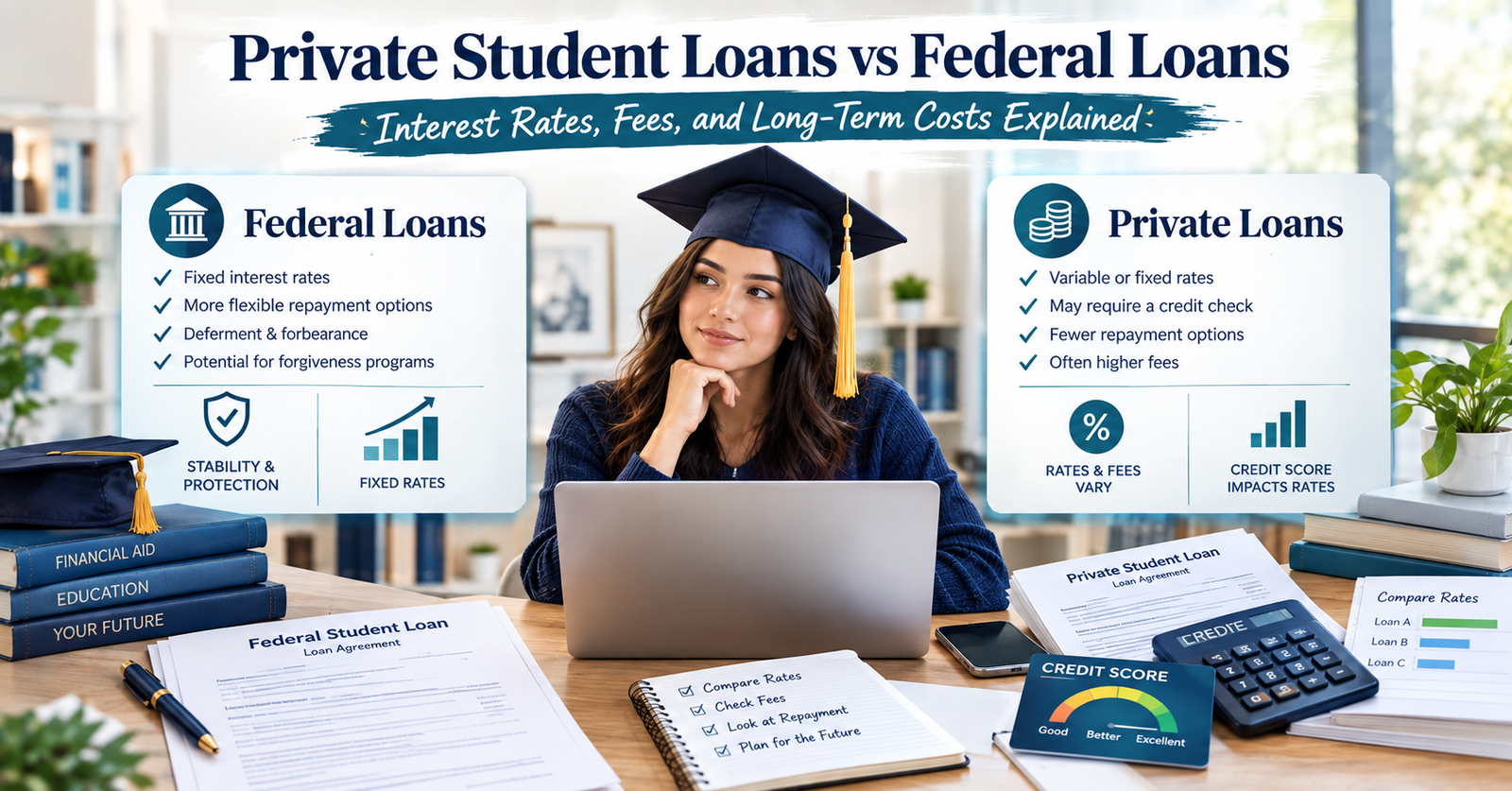
Federal vs Private Student Loans at a Glance
| Feature | Federal Student Loans | Private Student Loans |
|---|---|---|
| Provider | Federal government/Department of Education | Banks, credit unions, and private lenders |
| Interest rate | Generally fixed for current federal loans | Fixed or variable depending on lender |
| Credit check | Generally not required for most federal Direct loans | Commonly required |
| Cosigner | Usually not required for federal Direct loans | May be required |
| Repayment flexibility | Generally broader | Depends on lender |
| Income-based options | Available for eligible federal loans/programs | Usually more limited |
| Forgiveness programs | Some federal programs may apply | Generally not equivalent to federal programs |
| Terms | Governed by federal program rules | Set by lender and loan contract |
These are broad differences, not guarantees for every individual loan.
Always check the specific loan terms you are being offered.
ALSO READ ABOUT : How Much Does a Good Credit Score Save You on Student Loans, Auto Loans, and Mortgages?
What Is a Federal Student Loan?
Federal student loans are education loans associated with the federal student aid system.
They are different from loans offered directly by private banks or other private lenders.
One major advantage is that federal loans generally come with borrower protections and repayment options that private loans do not offer to the same extent.
Federal Student Aid and the CFPB both emphasize the importance of understanding these differences before choosing a private loan.
What Is a Private Student Loan?
Private student loans are provided by private financial institutions and other private lenders.
They may help students cover education expenses when other sources of funding are not enough.
Private loans can have fixed or variable interest rates.
The rate you receive can depend heavily on your credit history, credit score, income, and whether you have a cosigner.
Private loans can therefore look very different from one lender to another.
That makes shopping around particularly important.
Interest Rates: The First Big Difference
Interest is the cost of borrowing money.
The higher the rate, the more expensive the loan can become.
Federal student loans generally have fixed interest rates, meaning the rate does not change over the life of the loan.
Private student loans may offer either fixed or variable rates.
A fixed rate gives you more predictability.
A variable rate can change over time according to the loan’s terms.
That means you should not compare only the starting rate.
A private loan advertised at a lower initial rate may not remain cheaper if the rate is variable and later increases.
Fixed vs. Variable Rates in Simple Terms
Think of it this way.
Fixed rate
Your rate stays fixed according to the loan agreement.
This makes it easier to predict future payments.
Variable rate
Your rate can change.
The starting rate may be attractive, but your future payment can change if the rate changes.
For someone creating a long-term budget, predictability can be valuable.
Are Federal Loans Always Cheaper?
Not necessarily in every possible situation.
But federal student loans often have important advantages, and federal Direct loans are generally the preferred starting point for many student borrowers. The CFPB advises exploring federal options before private borrowing because federal loans generally provide more flexible repayment protections.
Private lenders can sometimes offer competitive rates to borrowers with strong credit.
For example, a graduate with excellent credit and a strong income profile may receive a private offer that looks attractive.
But the interest rate is only one part of the comparison.
Look Beyond the Rate
Imagine two loans:
Loan A
5.5% fixed
Loan B
5.0% variable
At first glance, Loan B appears cheaper.
But what happens if the variable rate rises?
Now imagine that Loan A provides better repayment flexibility while Loan B has stricter terms.
The 0.5 percentage-point difference does not tell the whole story.
This is why you should compare:
- Interest rate
- APR
- Fees
- Repayment term
- Monthly payment
- Total repayment
- Rate type
- Cosigner requirements
- Deferment options
- Forbearance options
- Other borrower protections
What Is APR?
APR stands for Annual Percentage Rate.
It is broader than the simple interest rate because it can include certain fees associated with the loan.
That makes APR useful when comparing borrowing costs.
However, APR should still be reviewed alongside the complete loan agreement.
A borrower should understand exactly what they are paying and under what conditions.
Federal Loans and Credit Checks
One major difference is how credit is used.
Most federal Direct student loans do not require a traditional credit check for eligibility, although there are exceptions such as certain PLUS loans.
Private student lenders commonly use credit history and credit scores when evaluating borrowers.
That can create a problem for younger students.
A student may have:
- Little credit history
- Low income
- No long-term employment history
As a result, they may need a cosigner or receive a less favorable rate.
What Is a Cosigner?
A cosigner is someone who agrees to be legally responsible for the debt if the primary borrower does not repay it.
Private student loans may require cosigners.
A cosigner with stronger credit may help a borrower qualify or receive better terms.
But this is a serious responsibility.
The cosigner is not simply helping with an application.
They can be financially responsible for the loan.
Students and families should discuss this carefully before signing.
Repayment Flexibility
This is one of the biggest differences between federal and private student loans.
Federal student loans generally provide more repayment options.
Depending on the borrower’s loan type and circumstances, federal programs may offer repayment structures tied to income and options for borrowers experiencing financial hardship.
Private lenders may offer deferment or forbearance, but these options vary by lender and contract.
Do not assume that a private loan provides the same protections as a federal loan.
What If You Lose Your Job?
This is where flexibility becomes especially important.
Imagine two graduates.
Both owe $40,000.
One has a federal loan.
The other has a private loan.
Both lose their jobs.
Their options may be very different.
Federal borrowers may have access to specific repayment or hardship programs depending on their circumstances and loan type.
The private borrower has to review the lender’s specific policies.
That does not mean a private lender will provide no assistance.
It means the terms are different.
What About Income-Driven Repayment?
Certain federal student loans can qualify for income-driven repayment programs.
These plans can base payments on factors such as income and family size, depending on the program and borrower eligibility.
Private student loans generally do not offer the same federal income-driven repayment system.
This can be an important difference for borrowers whose income may be unpredictable after graduation.
What About Loan Forgiveness?
Federal student loans may qualify for certain federal forgiveness programs if the borrower meets the program requirements.
One example is Public Service Loan Forgiveness for qualifying borrowers who meet the applicable requirements.
Private student loans generally do not provide equivalent federal forgiveness programs.
That does not mean every federal borrower will receive forgiveness.
Eligibility depends on the program, loan type, employment, repayment history, and other requirements.
The important point is that refinancing or replacing federal loans with private debt can affect eligibility for federal benefits.
Why Private Loans Can Still Make Sense
It would be misleading to say private student loans are never useful.
Sometimes students have education costs that are not fully covered by scholarships, grants, savings, federal aid, or other resources.
A private loan may fill a remaining funding gap.
The CFPB recommends exploring federal options first and then comparing private options if additional borrowing is necessary.
The key is to borrow carefully.
The Real Cost of Borrowing
Students often focus on:
“How much can I borrow?”
A better question is:
“How much will this money cost me over time?”
Suppose you borrow $20,000.
That $20,000 is not necessarily the amount you will eventually repay.
You may repay:
- Principal
- Interest
- Potential fees
The total depends on the rate, repayment period, payment schedule, and other loan terms.
That is why the cheapest loan is not necessarily the one with the largest amount available.
It is the loan that provides the necessary funding at a manageable total cost and acceptable level of risk.
Longer Repayment vs. Shorter Repayment
A longer repayment term can make monthly payments smaller.
That can be helpful when your income is limited.
But longer repayment can also mean paying interest for more years.
For example:
Shorter term
Higher monthly payment
Lower total interest
Longer term
Lower monthly payment
Potentially higher total interest
There is no universal “best” term.
The right choice depends on your budget and financial goals.
Don’t Borrow Just Because You Qualify
This is an important lesson for students.
A lender may tell you that you qualify for a certain amount.
That does not mean you should borrow the full amount.
Before borrowing, estimate:
- Tuition
- Housing
- Food
- Transportation
- Books
- Fees
- Other living expenses
Then consider scholarships, grants, savings, work income, payment plans, and other funding sources.
Borrow only what you reasonably need.
A Simple Example
Imagine your annual education costs are:
$30,000
You receive:
$10,000 in scholarships and grants
Your family contributes:
$5,000
You earn:
$3,000
That leaves:
$12,000
Before immediately borrowing the full $30,000, it makes sense to calculate the actual remaining funding gap.
This sounds obvious, but students can overlook it when faced with a large financial aid package.
Compare Offers Like a Shopper
If you need a private loan, do not accept the first offer automatically.
Compare:
Interest rate
Is it fixed or variable?
APR
Does the APR reveal additional loan costs?
Fees
Are there origination or other charges?
Repayment term
How many years will you make payments?
Monthly payment
Can you realistically afford it?
Total repayment
How much will you repay from beginning to end?
Cosigner
Is one required?
Cosigner release
Can the cosigner eventually be released?
Hardship options
What happens if you temporarily cannot make payments?
These details can be more important than a flashy advertised rate.
A Beginner’s Borrowing Order
A simple approach is:
1. Scholarships and grants
These generally do not require repayment.
2. Savings and other available resources
Use resources that make sense for your situation.
3. Federal student loans
Explore the federal options for which you qualify.
4. Payment plans and other school options
Your school may offer installment plans or other ways to manage costs.
5. Private student loans
Consider these when a funding gap remains and you understand the terms.
This is not a universal formula, but it provides a useful starting framework.
What About Graduate Students?
Graduate students may face much larger education costs.
They may also have different federal borrowing options than undergraduate students.
That makes comparing the total cost of attendance especially important.
A graduate degree can potentially improve future earning opportunities, but borrowing decisions should still be based on realistic expectations.
Consider:
- Total tuition
- Living costs
- Existing debt
- Expected career income
- Job prospects
- Repayment timeline
Do not evaluate a graduate loan only by asking whether you can get approved.
Ask whether the expected financial outcome makes sense for you.
International Students
International students may have fewer federal student loan options because federal aid eligibility depends on citizenship and qualifying status.
Private lenders may have different eligibility rules.
Some private lenders may require a U.S. cosigner, while others have specialized programs.
The exact requirements vary considerably.
International students should verify eligibility directly with the school and lender rather than assuming that a loan available to one student will be available to another.
What Happens if You Later Want to Refinance?
A borrower with private student loans may later consider refinancing.
For example, after graduation, your credit and income may improve.
You could potentially qualify for a lower rate.
But if you have federal loans, refinancing them into private debt requires much more caution because you may lose federal benefits and protections.
That is why the cheapest-looking interest rate is not always the best financial decision.
A Simple Decision Checklist
Before taking a student loan, ask:
Do I need to borrow this amount?
Have I explored grants and scholarships?
Have I checked my federal options?
Is the rate fixed or variable?
What is the APR?
Are there fees?
How much will I repay in total?
Can I afford the payment after graduation?
What happens if my income is lower than expected?
Does the loan require a cosigner?
What protections are available if I experience financial hardship?
If you cannot answer these questions, slow down before signing.
The Bottom Line
Federal and private student loans are not interchangeable.
Federal student loans generally offer important protections and repayment options that private loans may not provide.
Private loans can still be useful when a funding gap remains, particularly for borrowers who qualify for competitive rates and understand the terms.
The biggest mistake is choosing a loan based only on the advertised interest rate.
Instead, compare the entire financial picture:
- Interest rate
- APR
- Fees
- Fixed vs. variable
- Monthly payment
- Total repayment
- Repayment flexibility
- Cosigner requirements
- Borrower protections
- Future financial risk
For many students, the sensible starting point is to understand and use available federal options before considering private borrowing.
And remember one simple rule:
The amount you can borrow is not necessarily the amount you should borrow.
A student loan is future income committed today.
Understanding the cost before you sign can make the financial side of college much easier to manage later.
ALSO READ ABOUT : Student Loan Refinancing vs Consolidation Which Option Saves More Money After Graduation?
Frequently Asked Questions
Are federal student loans better than private student loans?
For many borrowers, federal loans are the better starting point because they generally provide more flexible repayment options and borrower protections. Individual circumstances can differ.
Do private student loans have fixed interest rates?
Some private loans have fixed rates and others may have variable rates. Check the specific loan agreement.
Do private student loans require a cosigner?
Some do, particularly when the borrower has limited credit history. Requirements vary by lender.
Can private student loans be forgiven?
Private loans generally do not offer the same federal forgiveness programs available to eligible federal borrowers.
Should I refinance federal student loans into private loans?
A lower private rate may look attractive, but refinancing federal loans can cause you to lose federal benefits and protections. Carefully compare the trade-offs before making a decision.
What should I compare when choosing a student loan?
Compare the interest rate, APR, fees, repayment term, monthly payment, total repayment, rate type, cosigner requirements, and available hardship or repayment options.
Editorial Note
This article is intended for general educational purposes and is not financial, legal, tax, or professional advice. Student loan programs, eligibility rules, interest rates, and repayment options can change. Always verify current information with your school, lender, Federal Student Aid, or another appropriate official source before making a borrowing decision.
1 thought on “Private Student Loans vs Federal Loans Interest Rates, Fees, and Long-Term Costs Explained”